
Swim
Pool work with a purpose.
Technique, aerobic, and threshold sessions use swim-specific structure and targets, including critical swim speed when your history supports it.
Triathlon training
From learning your first transitions to chasing an age-group win, Diorama treats swim, bike, and run as one connected sport. The plan scales with your experience, recovery, schedule, and race goal.
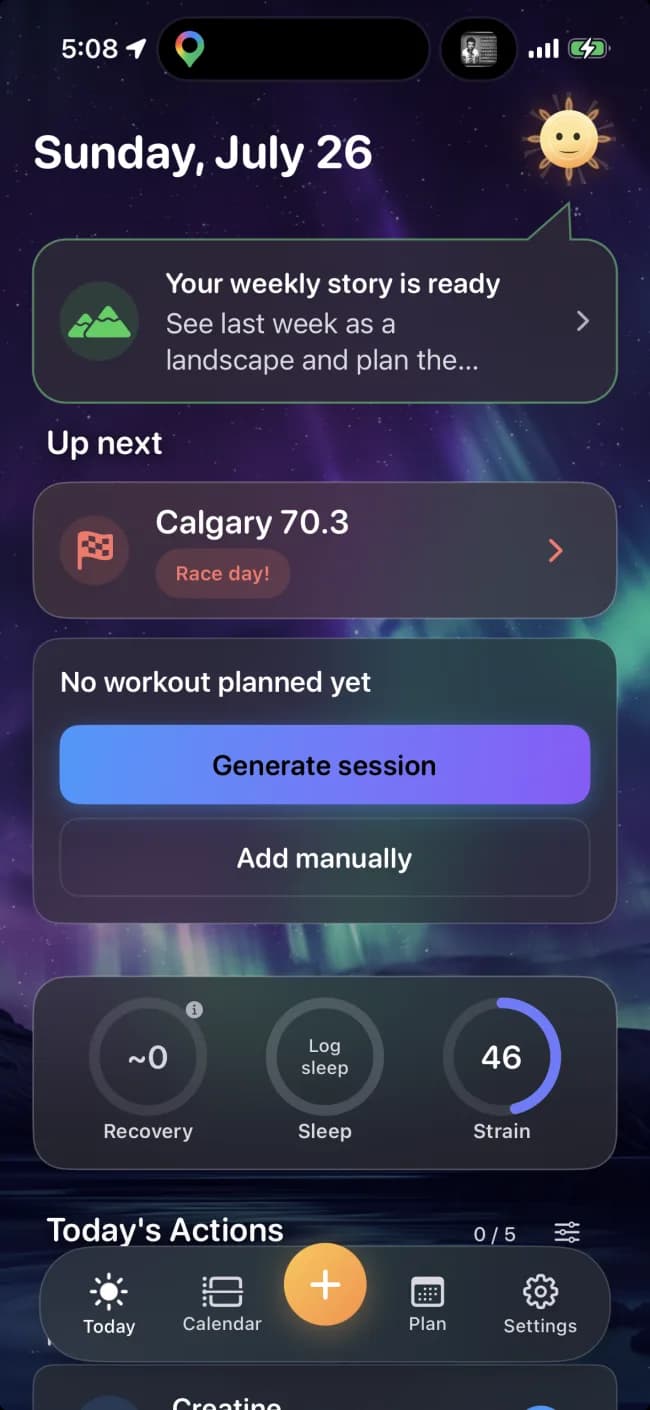
Race day, recovery, and the rest of life stay in one view.
One sport, three disciplines
Each discipline gets its own workout language and thresholds. The templates space the work across the week, mark key, long, limiter, brick, and rehearsal sessions, and keep those priorities visible when the plan changes.
Swim
Technique, aerobic, and threshold sessions use swim-specific structure and targets, including critical swim speed when your history supports it.
Bike
Endurance rides, threshold work, and race-specific sessions resolve against your own FTP or a sensible fallback when data is still thin.
Run
Easy, tempo, and interval work is balanced against the swim and bike sessions already in the week.
Deterministic by design
AI can help you express the goal and work through a changing week. It does not invent the training logic. Microcycles, target resolution, weekly-hour trimming, and readiness rules keep the plan bounded and repeatable. AI personalization starts from that deterministic structure and stays inside guardrails.
Distance, date, available weekdays, focus sport, and a weekly-hours cap set the boundaries.
Distance- and phase-specific microcycles define the sport mix, session roles, durations, and brick placement.
Swim CSS, bike FTP, run threshold pace, and LTHR turn intent into personal numbers.
Readiness can reduce, downgrade, substitute, or replace work through explicit rules recorded on the session.
Adaptive from day one
The same triathlon engine can teach the basics or sharpen an established race program. Your experience, recent training, available hours, distance, and readiness shape what comes next.
If you are a beginner
Diorama starts with a conservative, technique-first plan instead of assuming you already know the language of triathlon. The work gets more specific as your confidence and training history grow.
If you already race
Experienced triathletes get distance-specific volume, personal swim, bike, and run targets, limiter focus, and a plan that respects the training they have already earned.
Beginner milestones
Progress is shown as preparation, not a grade. You can see what you have practiced and what still needs attention before race morning.
Technique and consistency before chasing volume.
Helmet, mount, dismount, and T1/T2 order.
Sighting, breathing, wetsuit, and start-line skills.
Gear, logistics, fueling, timing, and what happens next.
From season to next session
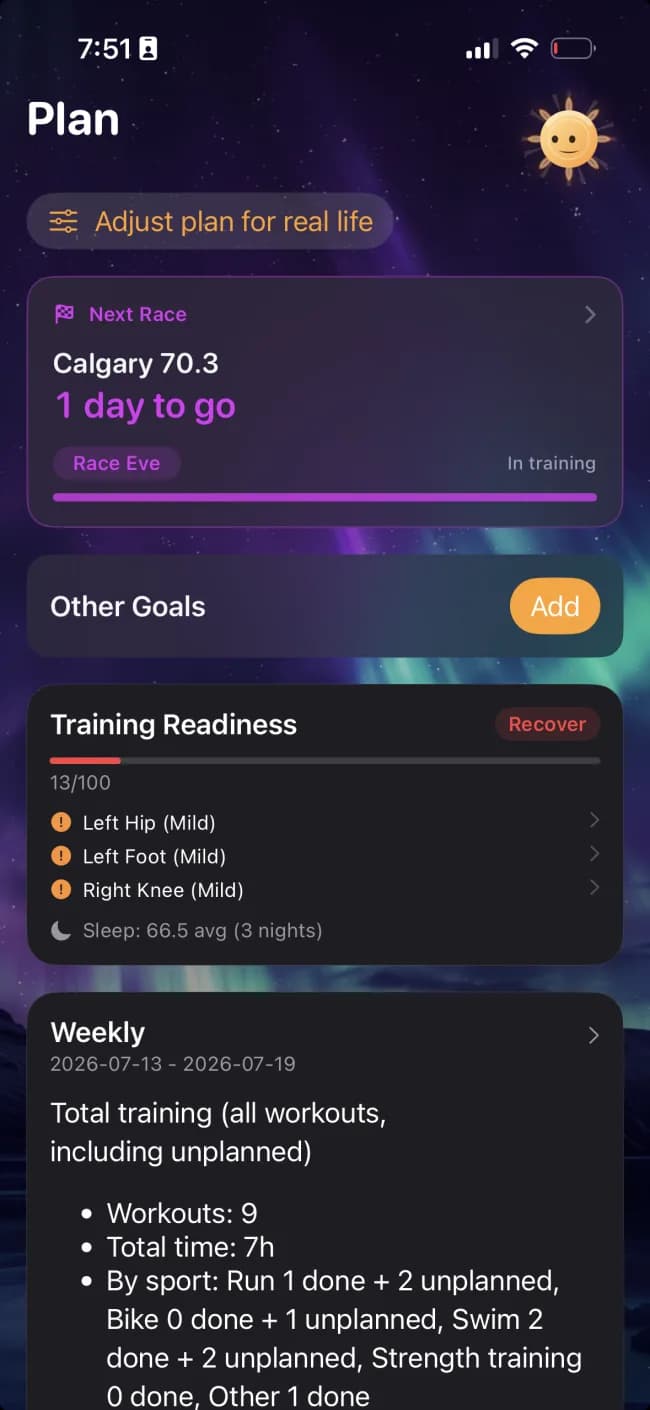
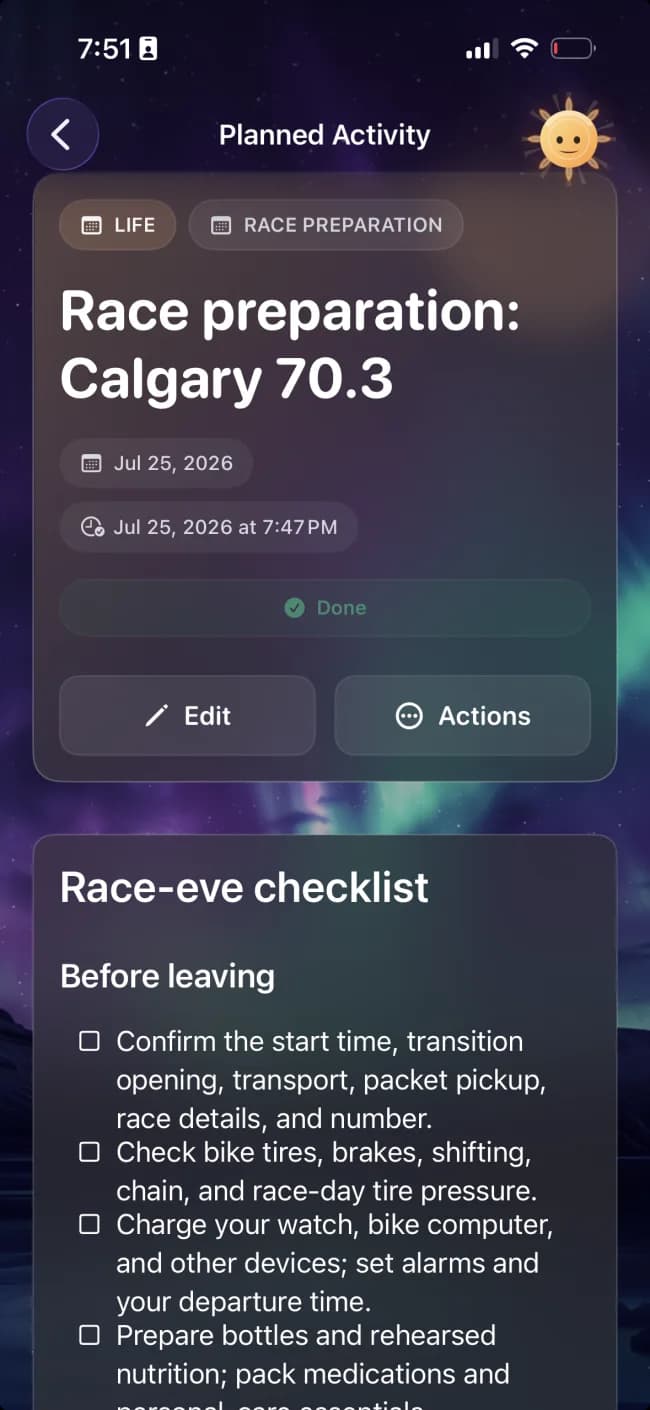
Your race and phase keep the season pointed in the right direction. Readiness, pain, sleep, and recent load shape how the work lands today. Race preparation includes the practical details, from transition timing to rehearsed nutrition and charged devices.
Triathlon-specific features
First-timers get technique-first progressions, teaching touchpoints, transition rehearsals, and preparedness tracking. Experienced athletes start from the training history and targets they already have.
Sprint, Olympic, 70.3, and Ironman use distinct session durations across base, build, peak, race-specific, and distance-aware taper phases.
Choose a swim, bike, or run focus and set 5–25 weekly hours. Limiter, brick, long, and fuel-rehearsal sessions are protected first when the week is trimmed.
Linked bike-to-run sessions and transition guidance prepare you for the specific demands of race day.
70.3 and Ironman long sessions and bricks carry phase-aware carbohydrate, fluid, sodium, and tolerance-practice notes.
Ask Ray how many gels your race needs. A deterministic calculator turns your weight, race duration, and the conditions into per-hour carbohydrate, fluid, and sodium targets — and the servings to carry — grounded in published sports-science ranges.
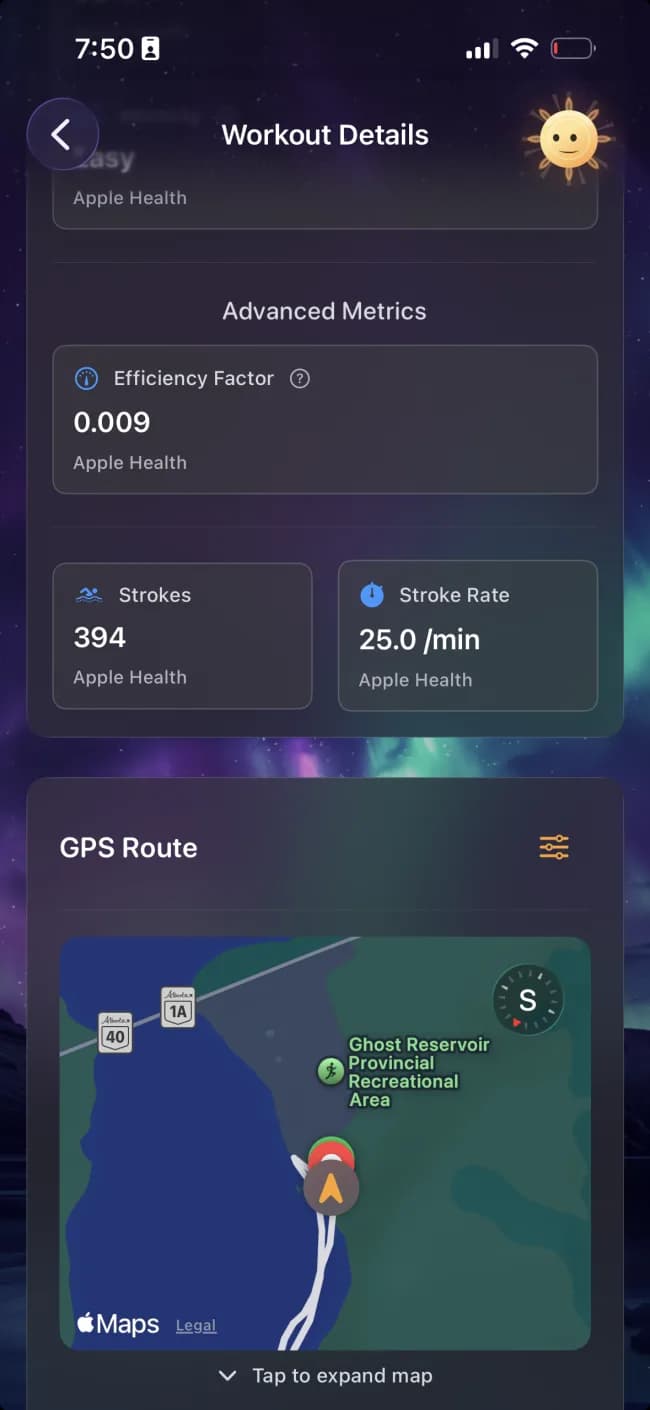
Post-workout coaching reads swim efficiency, bike pacing and cadence, run decoupling, or bike-to-run transition execution in the language of that sport.
Goal Detail shows swim, bike, and run status, a key risk, and one focus action. Inside four weeks, it adds a final-month triathlon summary.
Distance-appropriate rehearsals practice pacing, fueling, and transitions before taper, with reduced distance for longer races.
A protected race-eve session follows race-date edits and carries a deterministic triathlon checklist for gear, logistics, rehearsed nutrition, pacing, timing, and sleep.
Heat, humidity, altitude, and unsafe conditions can scale, downgrade, or replace a planned session while preserving the reason.
Three build weeks lead into a reduced-load recovery week that keeps technique and sport frequency in place. Readiness can still downgrade or replace work when the day calls for it.
When strength is included, mixed-sport templates place durability work in base and selected build weeks, then remove it from taper.
Your effort, in every sport
The template describes the purpose of the work. Your own history turns that purpose into pace, power, heart rate, and swim targets. Confidence is shown when the data is still developing.
First-triathlon learning
These short guides come from the same beginner modules that ground Ray in the app. There is no email gate: read what helps, check your race briefing, and decide whether a connected plan is useful for you.
First-triathlon swim basics are the skills that make the water task understandable: exhale with your face in the water, turn to the side for a calm inhale, keep a comfortable body line, and look forward briefly to sight when you need to check direction. Build these in a pool first. The goal is a repeatable rhythm, not a heroic first session.
Read the guide →Open-water confidence is a collection of skills, not a toughness test. Start by practising a relaxed exhale and occasional sighting in the pool. When a supervised venue is available, learn how your wetsuit feels, lift your eyes briefly without stopping your stroke, and return to a calm rhythm. A mass-start simulation comes last, after the basics feel familiar.
Read the guide →Transitions are the two changeovers inside a triathlon, and the clock runs through both of them. T1 is swim to bike: you come out of the water, run to your rack spot, pull off wetsuit, cap and goggles, put your helmet on and fasten it, take your bike off the rack, and run it to the mount line before you ride. T2 is bike to run: you get off at the dismount line, run the bike back to your spot, rack it, take your helmet off, change your shoes, and go. People call transitions the fourth discipline because they are scored like racing but practised like nothing else in the sport.
Read the guide →Running off the bike is the short run that follows cycling in a triathlon or brick session. The first minutes can feel awkward because you are changing from pedalling to running while carrying accumulated effort. A beginner practice is deliberately brief: rack the bike, change safely, start at a controlled effort, and let the run rhythm settle before deciding what you have.
Read the guide →A first-triathlon kit is the small set of items you need to swim, bike, run, and change between them. Group it by when it is used: swim items, bike items, run items, and a few transition basics. Lay it out in sequence before race week so omissions are visible early.
Read the guide →Race morning is a sequence: confirm the event schedule, travel with time for uncertainty, set up only what the organiser permits, learn the route to swim exit and bike-in, and attend the briefing. A written sequence is more useful than trying to remember everything under stress.
Read the guide →A triathlon glossary is a map of the words you will hear before, during, and after a race. T1 is the swim-to-bike transition and T2 is the bike-to-run transition. A brick is a training session that combines two disciplines in sequence, usually bike then run. A buoy is a floating course marker, cadence is the rate you pedal, and DNF means did not finish. A trisuit is clothing worn through more than one leg, while a timing chip records your time through the event.
Read the guide →For your first sprint and your fastest 70.3
Start from your history, follow a plan you can understand, and keep sleep, recovery, pain, and the rest of life in the same picture.